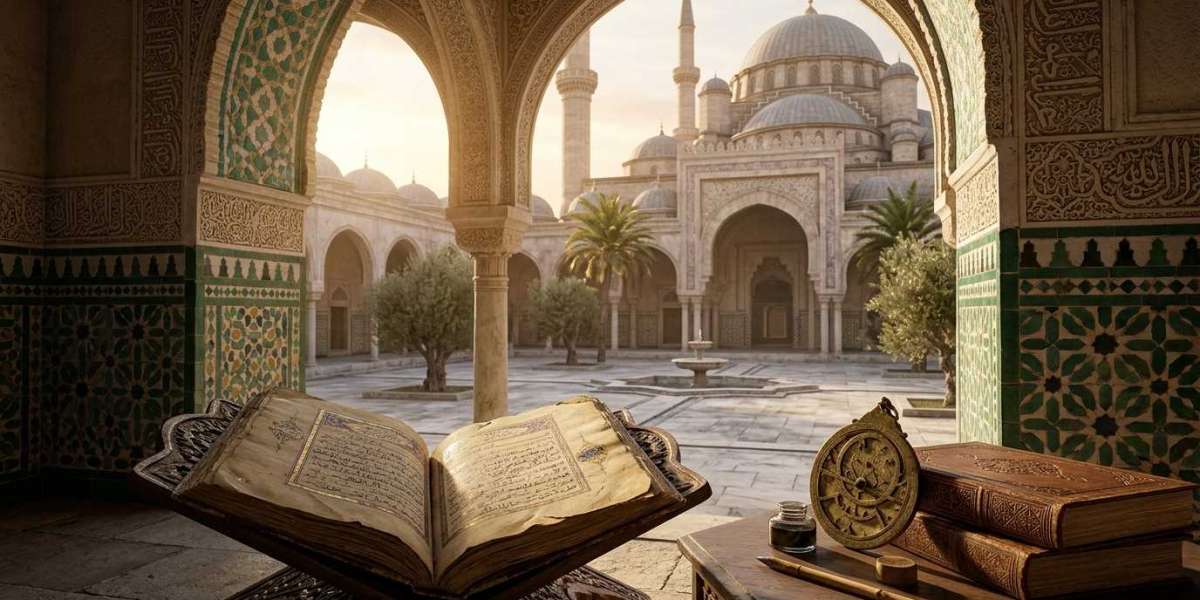
Islamic civilization has developed across many regions and centuries, leaving a lasting influence on education, architecture, literature, science, trade, and community life. An Islam Article about this heritage can help readers understand how religious principles, historical events, and cultural experiences contributed to the development of Muslim societies. From the early Muslim community in Arabia to major centers of learning across Asia, Africa, and Europe, Islamic history includes a wide range of achievements and traditions.
Islamic civilization was never limited to one language or ethnic group. Muslim communities developed in different environments and interacted with neighboring cultures, creating diverse traditions while maintaining important shared religious beliefs. Understanding this history requires looking at both its spiritual foundations and its broader cultural development.
The Early Muslim Community
Islam emerged in the seventh century in the Arabian Peninsula. Prophet Muhammad, peace and blessings be upon him, received the first revelations in Makkah and began calling people toward the worship of one God.
The early Muslim community faced opposition and hardship. The migration from Makkah to Madinah, known as the Hijrah, became a major event in Islamic history. It marked the beginning of a new stage in the development of the Muslim community.
In Madinah, Muslims established a community with shared religious and social responsibilities. The importance of cooperation, mutual support, justice, and community relationships became central themes in its development.
The early history of Islam also includes the efforts of the Prophet's companions, who preserved and transmitted religious teachings. Their role is significant in understanding how the Muslim community developed after the Prophet's lifetime.
The Expansion of Muslim Societies
After the death of Prophet Muhammad, peace and blessings be upon him, Muslim communities expanded into different regions. Over time, Islamic civilization developed across parts of the Middle East, North Africa, Central Asia, South Asia, and other areas.
This expansion brought Muslims into contact with different languages, customs, and intellectual traditions. Trade, travel, scholarship, and cultural exchange contributed to the development of diverse Muslim societies.
Historical developments were not identical in every region. Political systems, social conditions, and cultural practices varied across different periods. Studying these differences helps provide a balanced understanding of Islamic history.
The Growth of Education and Scholarship
Education has held an important place in Muslim intellectual history. Mosques, schools, libraries, and study circles became centers where people gathered to learn religious subjects and other areas of knowledge.
Scholars studied the Quran, Hadith, Arabic language, law, history, mathematics, medicine, astronomy, and philosophy. Their work helped preserve earlier knowledge while contributing to new discussions and discoveries.
Religious Scholarship
Islamic religious scholarship developed through the study of the Quran, Hadith, Arabic grammar, and jurisprudence. Scholars worked to understand religious texts, examine reports, and explain principles for different circumstances.
The development of schools of Islamic jurisprudence reflects the intellectual work of scholars across generations. Their methods and discussions remain important parts of Islamic educational history.
Libraries and Learning Centers
Libraries supported the preservation and circulation of books and manuscripts. In several historical Muslim cities, scholars, students, translators, and writers gathered in educational institutions and private study circles.
These environments encouraged discussion and the transmission of knowledge. Their influence extended beyond religious education to literature, medicine, mathematics, and other academic subjects.
Contributions to Science and Medicine
Muslim scholars contributed to different fields of scientific and intellectual study. Their work developed through the exchange of knowledge with Greek, Persian, Indian, and other traditions.
Mathematics
Mathematical scholarship in Muslim societies included developments in algebra, arithmetic, geometry, and practical calculation. These subjects were useful in trade, architecture, astronomy, and other activities.
Historical scholars helped organize and expand mathematical knowledge through written works and teaching.
Medicine
Medical scholarship developed through hospitals, educational centers, translations, and written medical references. Physicians studied human health, clinical observation, medicines, and medical practice.
Historical medical texts influenced later discussions and educational traditions in different parts of the world. Their significance can be understood within the broader history of medicine.
Astronomy
Astronomy was studied for scientific, navigational, and practical purposes. Observations of the sky supported the development of calendars and helped Muslims determine prayer times and the direction of Makkah.
Scholars developed astronomical tables and instruments, contributing to a wider history of scientific observation.
Islamic Architecture and Design
Islamic architecture is one of the most recognizable aspects of Muslim cultural heritage. It includes mosques, educational buildings, gardens, palaces, tombs, and public structures.
Architectural styles vary widely because Muslim societies developed in different climates and cultural environments. Materials, construction methods, decorative traditions, and building layouts reflect local influences as well as shared artistic themes.
Mosques and Community Spaces
Mosques are central places of worship and community gathering. Their designs may include prayer halls, courtyards, domes, minarets, and decorative elements.
Not every mosque follows the same architectural style. Some are simple and practical, while others feature detailed ornamentation and large structural designs.
Geometric Patterns and Calligraphy
Geometric patterns, floral designs, and Arabic calligraphy are widely associated with Islamic decorative arts. These elements appear in architecture, manuscripts, ceramics, textiles, and other forms of artistic expression.
Calligraphy has been particularly important because it provides a visual form for presenting Arabic writing, including Quranic verses and religious phrases.
Literature, Language, and Artistic Traditions
Arabic has an important role in Islamic religious life because the Quran was revealed in Arabic. Over time, many other languages became part of Muslim literary and cultural traditions.
Persian, Turkish, Urdu, Malay, and numerous regional languages developed rich bodies of writing within Muslim societies.
Poetry, historical writing, storytelling, educational texts, and religious literature helped preserve experiences and ideas across generations.
Artistic traditions also varied by region. Textiles, ceramics, metalwork, woodwork, manuscript decoration, and architecture demonstrate the diversity of creative expression within Islamic history.
Trade and Cultural Exchange
Trade helped connect Muslim societies with different parts of the world. Merchants traveled across land and sea routes, exchanging goods, ideas, languages, and cultural practices.
Commercial networks linked cities in the Middle East, Africa, Asia, and Europe. These connections supported economic activity and contributed to the movement of books, technologies, and artistic influences.
Trade also encouraged interaction between communities with different religious and cultural backgrounds. The history of these relationships was complex, but exchange played an important role in the development of many Muslim societies.
Islamic Heritage in South Asia
South Asia has a long and diverse history of Muslim communities, scholarship, architecture, and literature. Islam became part of the region through different historical processes, including trade, migration, teaching, and political developments.
Muslim rulers and local communities contributed to architecture, education, language, and public institutions. Historical buildings, mosques, gardens, manuscripts, and literary works remain part of the region's cultural heritage.
Languages such as Urdu developed through interactions among different linguistic and cultural communities. Their histories demonstrate how Islamic civilization adapted and developed in local environments.
Understanding Cultural Diversity in Islam
Muslim communities are not culturally identical. Clothing, food, languages, celebrations, architecture, and family customs may differ significantly between countries and regions.
Some traditions are connected to religious teachings, while others reflect local history and social customs. Distinguishing between religious principles and cultural practices is important when studying Muslim societies.
An informative Islam Article should recognize this diversity rather than presenting one regional tradition as representative of every Muslim community.
Preserving Islamic Historical Heritage
Historical buildings, manuscripts, libraries, museums, and archaeological sites provide valuable evidence of Muslim history. Preserving these resources helps future generations understand the achievements and experiences of earlier communities.
Educational institutions, historians, conservation specialists, and local communities all have roles in protecting cultural heritage.
Digital archives and carefully documented collections can also make historical materials more accessible. However, preservation requires accurate information, responsible interpretation, and respect for the communities connected to these places and objects.
Learning From Islamic History Today
Islamic history offers opportunities to understand how education, trade, architecture, scholarship, and community relationships developed across different periods.
Studying historical achievements should involve both appreciation and critical thinking. Historical societies faced challenges and disagreements, just as societies do today. A balanced approach recognizes achievements without ignoring complexity.
Reliable historical books, academic research, museum collections, and educational resources can help readers develop a deeper understanding of the subject.
Conclusion
Islamic civilization includes a wide range of historical experiences, intellectual achievements, artistic traditions, and cultural contributions. From early Muslim communities to educational centers, scientific scholarship, architecture, literature, and international trade, its history reflects the work of people from many regions and backgrounds. An Islam Article focused on this heritage can help readers understand how Muslim societies developed and influenced the wider world. Studying this history with reliable sources provides a more complete appreciation of its diversity and lasting significance.
Frequently Asked Questions
Where did Islamic civilization begin?
Islam began in the Arabian Peninsula in the seventh century, with Makkah and Madinah playing central roles in its early history.
What subjects did Muslim scholars study?
Muslim scholars studied religious sciences, mathematics, medicine, astronomy, language, history, philosophy, and other fields.
What are common features of Islamic architecture?
Mosques and other buildings may include domes, courtyards, minarets, geometric patterns, floral designs, and calligraphy. Features vary by region and period.
Which languages are part of Muslim literary heritage?
Arabic, Persian, Turkish, Urdu, Malay, and many other languages have important literary traditions connected with Muslim societies.
Why is preserving Islamic heritage important?
Preservation protects historical buildings, manuscripts, and cultural objects, helping future generations study and understand the past.