
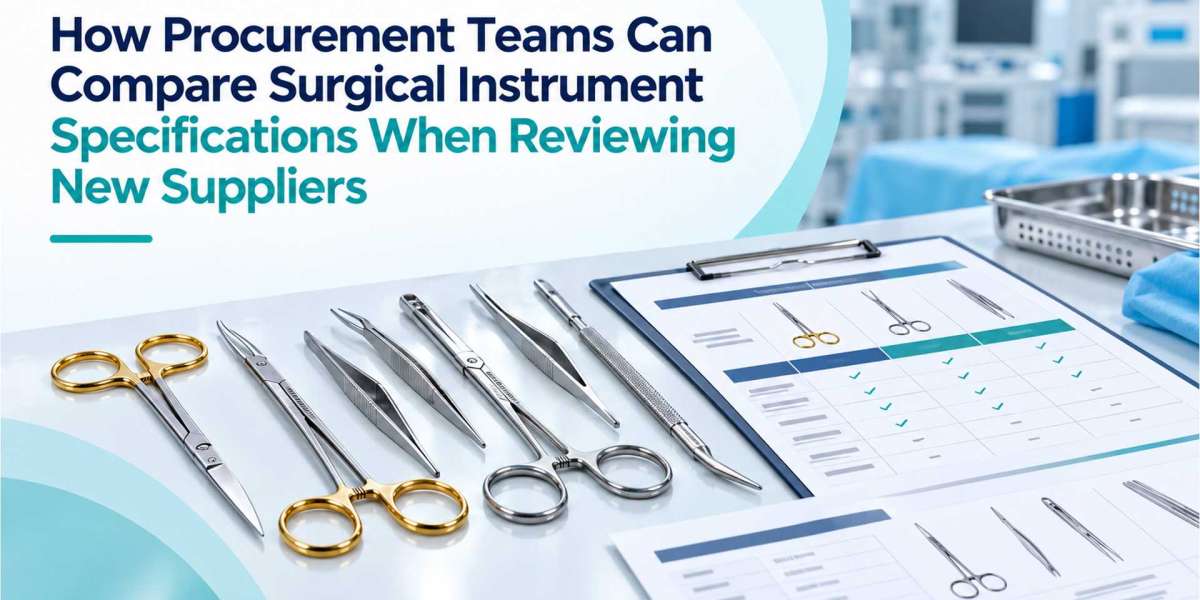
Adding a new Surgical Instrument Supplier requires more than finding a product with a similar catalogue name and comparing its unit price.
Hospitals and medical device distributors need to understand whether the candidate product addresses the technical requirement already defined by the organisation. That means reviewing dimensions, instrument configuration, connections, product presentation and supporting documentation before making a commercial comparison.
A structured specification review gives procurement teams a clearer way to evaluate products without assuming that similar names or appearances make two instruments interchangeable.
Begin With the Requirement, Not the New Supplier's Catalogue
The most reliable starting point is the requirement already established by the healthcare organisation.
Where an approved product is currently in use, its catalogue number and supporting technical information can provide useful context.
The objective is not to find an instrument that merely looks similar. It is to identify the characteristics that matter to the purchasing requirement and then assess how a candidate product is configured.
This creates a more disciplined comparison and gives the potential supplier better information to work with.
Identify the Product Family First
Before comparing individual instruments, confirm that the products belong to the same relevant product family.
Depending on the enquiry, this may involve:
bipolar forceps;
monopolar electrodes;
HF handles;
bipolar cables;
laparoscopic grasping instruments;
scissors;
trocars;
suction and irrigation instruments.
A product from a neighbouring category should not be treated as a direct comparison simply because it appears within the same surgical field.
Break the Existing Requirement Into Individual Specifications
A structured comparison becomes easier when the product is separated into individual technical characteristics.
For a bipolar forceps, the review may include:
instrument pattern;
length;
tip or distal configuration;
surface requirement;
cable arrangement;
equipment connection.
For a laparoscopic instrument, the important fields may instead include:
shaft diameter;
working length;
jaw, blade or electrode configuration;
monopolar or bipolar arrangement;
connection requirements.
This approach makes differences visible instead of allowing them to disappear behind a broad product title.
Use Exact Measurements Wherever Possible
Descriptions such as “long”, “standard”, “fine” or “small” can vary between manufacturers.
Where the relevant documentation provides exact measurements, those values should be used in the comparison.
Useful data may include:
total length;
working length;
shaft diameter;
tip width;
other reference-specific dimensions.
Exact measurements create a clearer technical discussion and make supplier quotations easier to review.
Compare the Working End Carefully
The distal or working end is often one of the most important differences between surgical instruments.
Two products may have a similar overall shape while using different:
jaw patterns;
tip geometries;
blade designs;
electrode configurations.
The purchasing team should document the required working-end characteristics rather than relying on product photographs alone.
Connected Accessories Need Separate Review
Electrosurgical products often depend on related components.
A bipolar forceps may require a cable. A monopolar electrode may need an HF handpiece. The cable or handle may then need to connect to a particular electrosurgical system.
This means a supplier review should sometimes consider the complete connection pathway rather than the instrument alone.
For example:
Bipolar instrument → cable → HF equipment
or:
Active electrode → HF handle → cable → HF equipment
If a connected component changes, the procurement team should establish whether that change affects the wider requirement.
Check What Is Included in the Quoted Reference
Two quotations can appear similar while including different components.
One forceps may be supplied with a cable, while another requires a separate cable purchase.
A laparoscopic system may include one component that is sold separately by another supplier.
Before comparing commercial terms, ask:
What exactly is included?
Are any accessories required separately?
Is the cable or connector part of the quoted product?
What quantity does the quoted unit represent?
This prevents incomplete commercial comparisons.
Packaging and Product Presentation Can Also Differ
For single-use instruments, product presentation may influence purchasing and stock management.
Relevant details can include:
individual packaging;
outer pack quantity;
sterile presentation where applicable;
shelf-life information;
storage conditions;
product labelling.
These details should be reviewed for the actual candidate product rather than assumed from another item in the same range.
Do Not Treat Specification Similarity as Proof of Interchangeability
A technical comparison can identify similarities and differences between products, but it should not automatically be interpreted as proof that two medical devices are clinically or technically interchangeable.
The healthcare organisation should apply its own evaluation and approval process, supported by the manufacturer's current product information.
This distinction keeps procurement comparison separate from clinical decision-making.
Review Supporting Product Documentation
Professional buyers may need more than a quotation before a new product can be considered.
Depending on the organisation and product, the review may involve:
technical specifications;
instructions for use;
product catalogue information;
packaging information;
relevant quality documentation;
applicable conformity information.
The documents requested should relate to the actual product being evaluated.
A Practical Supplier Comparison Matrix
| Review Area | Existing Requirement | Candidate Product |
|---|---|---|
| Product family | Required instrument category | Supplier's proposed category |
| Dimensions | Approved measurements | Published measurements |
| Working end | Required tip, jaw or blade configuration | Candidate configuration |
| Connection | Existing system requirement | Candidate connection |
| Included components | Current supply configuration | Items included in quotation |
| Product presentation | Required purchasing format | Candidate product presentation |
| Documentation | Internal review requirements | Available supporting information |
How Distributors Can Manage Supplier Reviews More Efficiently
Medical distributors can maintain a structured review record for important hospital accounts.
The record may include:
customer;
existing product number;
critical specifications;
candidate supplier;
candidate product number;
identified differences;
documentation status;
customer evaluation status.
This creates a more transparent sourcing process across commercial, technical and quality teams.
Better Supplier Information Makes Comparison Easier
Manufacturers can support professional buyers by presenting product families, dimensions, configurations and connected accessories clearly.
Distributors evaluating new supply relationships may also benefit from guidance on medical device sourcing for European distributors, particularly when building a structured approach to product and supplier review.
Questions to Ask Before Moving Forward
Are the products genuinely within the same required category?
Have all critical dimensions been compared?
Does the working-end configuration match the requirement?
Are cables, handles or other accessories involved?
What is included in each quotation?
Is the product presentation suitable for the purchasing requirement?
Is the necessary documentation available?
What internal review or approval remains necessary?
Conclusion
Reviewing a new surgical instrument supplier should be a structured technical and commercial process.
Clear specifications help procurement teams understand where products are similar, where they differ and which questions still need to be resolved.
By comparing product families, dimensions, working-end configurations, connections, included components and supporting documentation before focusing on price, hospitals and distributors can make supplier evaluations more organised and evidence-based.



