
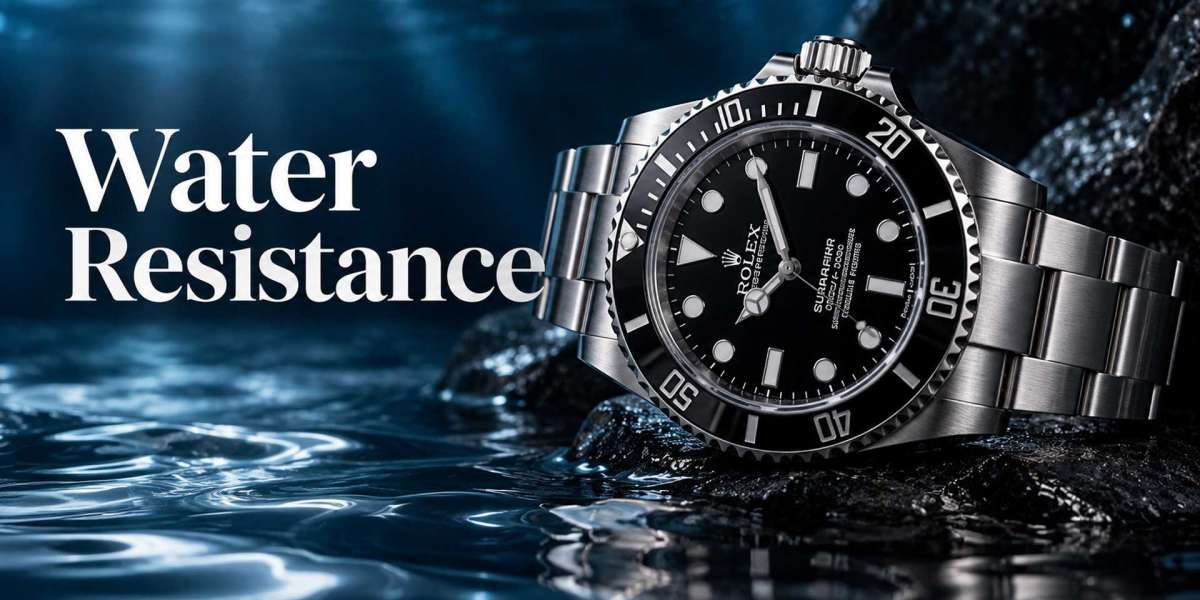
Your Watch Says 100 Meters. Does That Mean You Should Take It 100 Meters Underwater? Not So Fast.
A watch can look remarkably robust. A solid metal case, screw-down crown, and confident-looking specifications may suggest it is ready for anything.
Then you read the small print: water-resistant to 30 meters, 50 meters, 100 meters, or perhaps 200 meters.
What do those numbers actually tell you?
It's tempting to read them as straightforward depth limits. A watch marked 50 meters sounds as though it should be suitable for swimming 50 meters underwater.
That interpretation can be misleading.
Understanding watch water resistance explained in practical terms requires knowing how watches are rated, what manufacturers approve for particular activities, and why the condition of the individual watch matters.
These considerations become particularly important for owners of valuable mechanical watches and people purchasing pre-owned references whose maintenance histories are not fully documented.
What Does Water Resistance Mean on a Watch?
Water resistance describes a watch's designed ability to resist water entering its case under specified conditions.
Manufacturers achieve this using carefully engineered case structures, seals, crystals, crowns, pushers, and related components.
The rating is associated with testing and the watch's intended design.
It should not be interpreted as a permanent promise that the watch will resist water in every situation throughout its lifetime.
The exact conditions under which a watch may safely be used depend on its design, manufacturer's instructions, current condition, and maintenance.
Understanding 30m, 50m, 100m, and 200m Ratings
Water-resistance ratings are commonly expressed in meters, feet, bars, or atmospheres.
One bar is approximately equivalent to atmospheric pressure, and a rating expressed in meters is conventionally related to a specified pressure test.
But the number isn't a simple invitation to use the watch at that underwater depth.
The following table offers general examples based on common manufacturer classifications, not universal permission for every watch.
Typical Rating | General Interpretation | Important Limitation |
|---|---|---|
30m / 3 bar | Basic resistance to incidental splashes, depending on model | Normally not intended for swimming |
50m / 5 bar | Some manufacturers permit ordinary swimming | Check the exact model's instructions; not a diving rating |
100m / 10 bar | Some watches support swimming and greater water exposure | Not automatically suitable for scuba diving |
200m / 20 bar | Higher resistance; approved activities depend on classification | A 200m marking alone does not establish an ISO-certified diver's watch |
Designated diver's watch | Engineered for specified diving applications | Follow manufacturer and relevant diving-watch requirements |
A watch's exact instructions take priority over simplified internet charts. Different manufacturers may specify different permitted activities, even when the displayed pressure rating is similar.
Why 30 Meters Doesn't Mean Swimming at 30 Meters
The confusion begins when pressure ratings are treated as everyday depth instructions.
A 30m-rated watch is generally designed to tolerate limited water exposure such as occasional splashes, according to many manufacturers' classifications.
It is not normally a suitable choice for swimming or diving.
The stated rating reflects a specified test condition rather than unrestricted underwater use.
That distinction is important because ordinary activities can involve changes in pressure, temperature, and mechanical movement that differ from controlled testing.
Owners should therefore use the manufacturer's recommended activity classification, not the numerical depth alone.
Is a 50m Water-Resistant Watch Safe for Swimming?
This is where blanket statements become particularly unhelpful.
Some manufacturers specifically classify appropriate 5-bar watches as suitable for normal swimming.
Citizen, for example, publishes guidance allowing certain 5-bar watches to be used while swimming, while excluding more demanding activities such as skin diving.
That doesn't mean every older or pre-owned 50m watch can safely be taken into a pool.
The individual watch's seals, crown, case condition, and maintenance history still matter.
For an older watch or one with uncertain service history, professional assessment is sensible before intentional water exposure.
What Does 100m Water Resistance Mean for Daily Wear?
A 100m specification is common on many contemporary luxury sports watches.
For an appropriately designed watch in suitable condition, that rating may provide practical versatility for everyday activities and water exposure permitted by its manufacturer.
However, it doesn't automatically make the watch a professional diving instrument.
A watch with a 100m rating may have different crown construction, complication controls, and usage instructions from another watch displaying the same figure.
Always identify the actual reference rather than treating the rating as a complete specification.
Rolex as an Example
Rolex officially states that its Oyster Perpetual models are waterproof to depths of at least 100 meters, while certain specialized models have higher stated ratings.
The manufacturer also emphasizes the importance of correctly securing the winding crown.
That guidance illustrates why the case system and its proper operation matter alongside the number printed in the specifications.
The current condition of a pre-owned watch should still be assessed independently.
Are All 200m Watches Suitable for Scuba Diving?
No.
A general 200m water-resistance marking and a watch specifically designed and classified for diving are not necessarily equivalent.
Dedicated diver's watches can be subject to additional design and performance requirements, including those addressed by ISO 6425.
Features and testing expectations vary depending on the intended diving application.
Anyone considering a watch for actual scuba diving should rely on the specific manufacturer's instructions and appropriate diving equipment standards rather than a broad product description.
A valuable watch that merely looks like a dive watch should not be assumed suitable for demanding underwater use.
Why Water Resistance Can Change Over Time
A water-resistance specification describes the design and testing of the watch. It doesn't mean the watch remains permanently sealed without maintenance.
Seals and gaskets can deteriorate. Crowns can experience wear or damage. A crystal may have been replaced or the case opened during servicing.
Exposure to temperature changes, chemicals, and impacts can introduce additional concerns.
This is particularly relevant to vintage watches and older pre-owned watches.
An attractive exterior doesn't demonstrate the condition of the internal sealing system.
The Pre-Owned Watch Rule
If you're uncertain whether a watch has been pressure-tested or appropriately maintained, avoid deliberate water exposure until its condition has been assessed.
This precaution is especially worthwhile when the watch has a valuable mechanical movement or when moisture damage could affect historically important components.
Why the Crown and Pushers Matter
The crown is used to wind and set many mechanical watches. Chronograph pushers operate additional functions on selected models.
These openings require carefully designed sealing arrangements.
On a watch with a screw-down crown, the crown must be secured according to the manufacturer's instructions before appropriate water exposure.
Don't operate a crown or pusher underwater unless the particular model is explicitly designed and approved for that action.
There is no universal rule that every chronograph pusher can be safely operated in water.
Different constructions have different limitations.
Can You Shower With a Luxury Watch?
A manufacturer may permit washing or certain water activities for a particular watch, but that doesn't mean showering is always advisable.
Hot water, steam, soaps, and other products can introduce conditions that differ from the circumstances addressed by a standard water-resistance rating.
Watches with leather straps bring an additional consideration because repeated water exposure can affect the strap material.
When in doubt, remove the watch rather than assuming that a high numerical rating settles every question.
What Happens If Water Gets Inside a Mechanical Watch?
Water intrusion can damage components that depend on controlled lubrication and clean operating conditions.
Potential consequences include corrosion, dial damage, deterioration of hands, and mechanical problems.
Visible condensation beneath the crystal is a warning sign that deserves prompt attention.
If you suspect moisture has entered the watch, avoid operating its crown and pushers unnecessarily and seek qualified professional assistance promptly.
Do not attempt improvised heat treatments or place a valuable watch in an oven or other unsuitable drying environment.
Five Checks Before Buying a Water-Resistant Luxury Watch
For an online purchase, ask questions that relate to the actual watch rather than relying exclusively on the collection name.
Exact reference: What is the manufacturer's stated water-resistance specification?
Current condition: Is there known damage to the crown, crystal, pushers, or case?
Service history: Is relevant maintenance information available?
Testing: Has the watch undergone a recent appropriate water-resistance assessment, if claimed?
Intended activity: Does the manufacturer permit the water exposure you're planning?
These questions provide a more useful foundation than simply choosing whichever watch has the largest number in its specifications.
Buyers can research individual luxury-watch references through Platinum Times Co. USA, then confirm the condition and relevant details of the particular watch under consideration.
Frequently Asked Questions About Watch Water Resistance
Can I swim with a 30m water-resistant watch?
Generally, 30m or 3-bar watches are not intended for swimming. Check the exact manufacturer guidance.
Does 50m water resistance mean I can swim?
Some manufacturers permit ordinary swimming with appropriate 5-bar watches. The model's instructions and its current condition determine whether that is advisable.
Is 100m water resistance good for everyday wear?
It can offer practical versatility, but actual permitted activities depend on the reference, manufacturer guidance, and sealing condition.
Is a 200m watch automatically a dive watch?
No. A dedicated diver's watch involves design and performance requirements beyond a general numerical rating.
Can water resistance wear out?
Yes. Seals, crowns, and other components may deteriorate or become damaged. An older watch may require appropriate maintenance or testing.
How can I tell if a pre-owned watch is waterproof?
The original rating is only a starting point. A qualified water-resistance assessment may be needed to establish the current condition.
What should I do if condensation appears inside my watch?
Seek professional help promptly and avoid unnecessary operation of crowns or pushers. Internal moisture can cause damage.
Final Thoughts: Read the Rating, Then Understand the Watch
A water-resistance rating is useful information, but it isn't the whole ownership story.
Thirty meters, fifty meters, one hundred meters, and two hundred meters describe different performance classifications. They should not be treated as straightforward permission to dive to those depths.
The correct decision depends on the exact reference, manufacturer instructions, current condition, and activity involved.
Considering a pre-owned luxury watch for everyday wear? Explore Rolex watch references available through Platinum Times Co. USA and ask about the condition of a specific listing before relying on its original water-resistance specification.
A little caution around water can protect a watch you hope to enjoy for many years.



