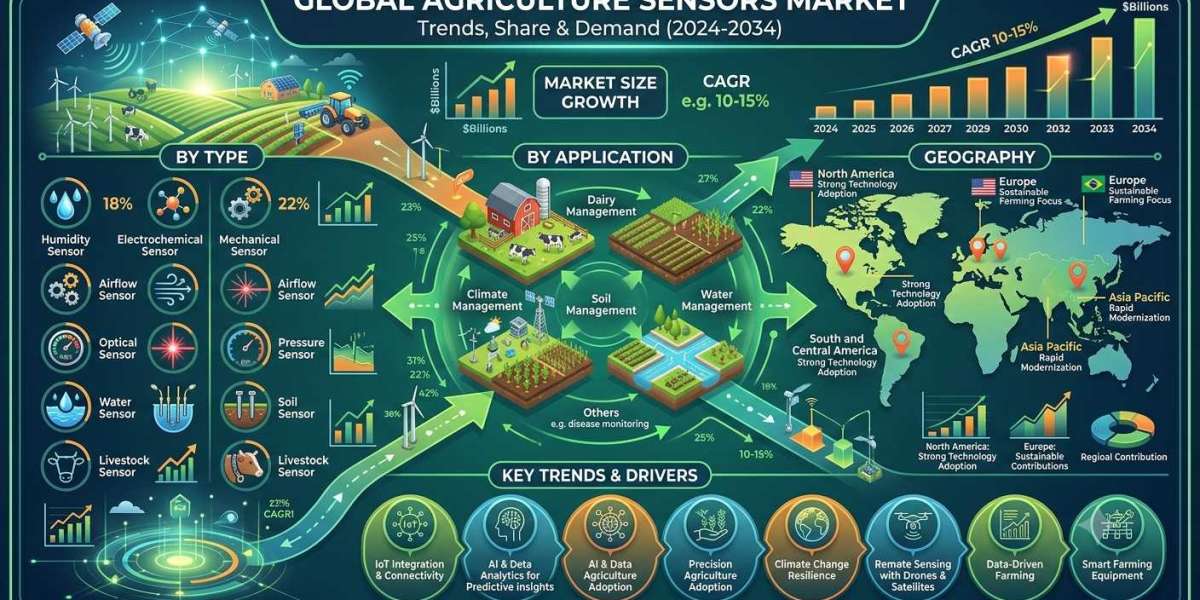
The adoption of precision farming technologies across North America is accelerating as agricultural producers seek greater productivity, efficient resource utilization, and improved crop-management capabilities. Large-scale farming operations in the United States are increasingly incorporating connected equipment, soil monitoring, remote sensing, automated irrigation, and data-driven decision-making into daily operations. The growing integration of sensors with farm machinery, IoT platforms, drones, and analytics is creating a strong technology ecosystem for advanced agricultural applications.
The Agriculture Sensors Market Size is projected to increase from US$2.66 billion in 2025 to US$6.61 billion by 2034, registering a CAGR of 12.05% during 2026–2034. The addressable opportunity is estimated at US$44.13 billion during 2026–2034. North America, particularly the US, represents an important region for adoption because of its established precision agriculture infrastructure, technologically advanced farms, and growing emphasis on connected agricultural systems. The United States is also investing in sensor, IoT, robotics, and data technologies through research and industry collaborations.
Download Sample PDF: https://www.theinsightpartners.com/sample/TIPRE00026893
US Precision Agriculture Adoption Drives Sensor Demand
The US is a major center for precision agriculture development, supported by large commercial farms and widespread use of technology-enabled agricultural equipment. According to the USDA Economic Research Service, precision agriculture adoption has increased substantially over the past two decades. In 2023, guidance autosteering systems were used by 52% of midsize farms and 70% of large-scale crop-producing farms, while yield monitors, yield maps, and soil maps were used by 68% of large-scale crop-producing farms.
This technological foundation creates opportunities for agriculture sensors because modern precision farming systems depend on reliable field-level data. Soil moisture sensors, temperature sensors, nutrient sensors, optical sensors, weather sensors, and crop-monitoring technologies can provide information that supports site-specific decisions.
Water Management Is a Major Growth Driver
Water conservation is becoming an important factor supporting sensor deployment across US agriculture. Sensors can provide real-time information about soil moisture, crop water stress, and field conditions, enabling farmers to optimize irrigation schedules and avoid unnecessary water application.
USDA-supported research is exploring sensor-based irrigation scheduling and integrated sensing systems for site-specific water and crop management. Research programs are also examining canopy temperature, soil water, vegetation indices, and other measurements to improve irrigation prescriptions.
This trend is particularly relevant in water-stressed agricultural areas of the western and southern US, where efficient irrigation can directly influence farm productivity and resource management.
Integration of IoT, AI, and Connected Farm Equipment
The North American agriculture sensors ecosystem is evolving beyond standalone measurement devices. Sensors are increasingly being connected with cloud platforms, artificial intelligence, machine learning, autonomous machinery, drones, and farm management software.
The USDA Agricultural Research Service is currently supporting projects that evaluate IoT, sensors, robotics, drones, autonomous technologies, and software for precision agriculture. These initiatives aim to improve connectivity, data pipelines, and decision-making for farms and ranches of different sizes.
AI integration is another emerging opportunity. USDA initiatives highlight the use of machine learning, satellite imagery, drone imagery, and ground-level data to monitor crop health, predict agricultural conditions, and support resource allocation.
Sensor Innovation Supports Sustainable Farming
Sustainability is another important driver across the US agricultural technology ecosystem. Producers are seeking ways to reduce unnecessary water, fertilizer, pesticide, and energy consumption while maintaining productivity. Precision agriculture technologies can support site-specific application of agricultural inputs and improve resource management.
Recent US research also demonstrates the direction of sensor innovation. USDA's National Institute of Food and Agriculture reported in February 2026 on research involving plant-wearable, soil, and stalk sensors designed to provide real-time information on crop water use and nitrogen conditions. The system combines sensor data with drone imagery, satellite information, and machine learning.
Such developments could broaden sensor applications from conventional soil and weather monitoring toward direct measurement of plant health and physiological conditions.
North America Competitive Landscape
The competitive landscape includes global sensor manufacturers, agricultural technology companies, precision agriculture providers, and agricultural equipment companies. Key companies associated with the Agriculture Sensors Market include Texas Instruments Inc., Robert Bosch GmbH, Trimble Inc., AG Leader, CropX Inc., Sentera, LLC, Pycno Agriculture, Avidor High Tech, Auroras s.r.l., and The Yield Pty.
Companies are focusing on improving sensor accuracy, wireless connectivity, energy efficiency, interoperability, and integration with agricultural machinery and digital platforms. In North America, partnerships between technology companies, universities, government agencies, and agricultural producers are also supporting the development and field validation of new sensing technologies. USDA research programs specifically emphasize collaboration with industry and agricultural stakeholders to accelerate the development and adoption of precision technologies.
Challenges and Opportunities in the US
Despite strong technology adoption, sensor deployment across US agriculture continues to face challenges. Rural connectivity, power availability, installation requirements, maintenance, data interoperability, cybersecurity, and upfront technology costs can affect adoption, particularly for smaller farms.
USDA research identifies the need for reliable outdoor sensor networks because agricultural land does not always have consistent power and communications infrastructure. Research initiatives are therefore focusing on long-lasting, lower-cost sensor networks and improved interoperability between devices and platforms.
These challenges are simultaneously creating opportunities for manufacturers developing low-power wireless sensors, solar-powered systems, secure data architectures, edge computing solutions, and interoperable agricultural platforms.
Future Outlook
The North American outlook for agriculture sensors is closely tied to the continued digitalization of US farming. Increasing adoption of precision agriculture, connected machinery, smart irrigation, autonomous equipment, drones, and AI-based crop analytics is expected to expand demand for real-time field data.
Future sensor systems are likely to become smaller, more connected, energy-efficient, and capable of collecting multiple parameters simultaneously. Integration with AI and digital twins could also enable farmers to move from monitoring conditions toward predictive and automated farm management.
With the global Agriculture Sensors Market projected to reach US$6.61 billion by 2034 at a CAGR of 12.05%, North America is positioned as an important innovation and adoption center, supported by advanced agricultural infrastructure, technology-oriented producers, and continuing investment in precision agriculture research.
About The Insight Partners
The Insight Partners is a globally recognized market research and consulting firm providing reliable and actionable insights across industries. The company offers comprehensive market research reports, industry analysis, strategic intelligence, and customized consulting services to help organizations understand emerging opportunities, technological developments, competitive dynamics, and growth trends.
Contact Us
The Insight Partners
Email: sales@theinsightpartners.com
Phone: +1-646-491-9876
Website: https://www.theinsightpartners.com
Related Reports -
Submarine Fiber Cable Market Demand, Share Growth by 2034
Aircraft Wiring Harness Market Dynamics and Trends by 2030
SCADA Oil and Gas Market Size, Trends Growth by 2034