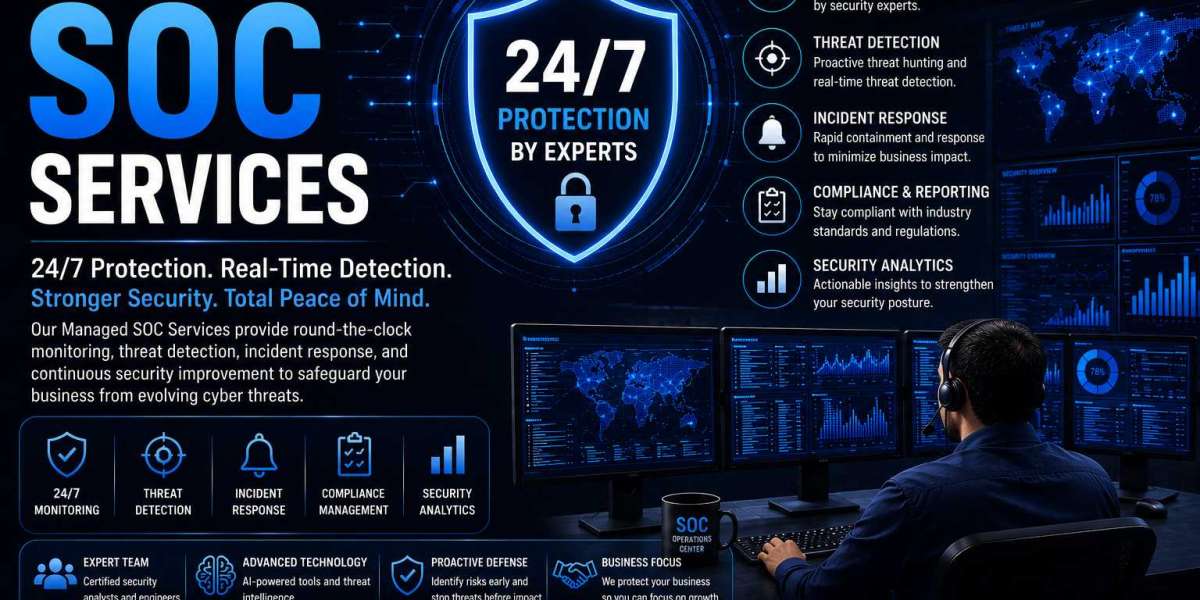
What Should ICT Businesses Expect From a Managed SOC Service?
Indian ICT businesses operate in an environment where networks, cloud platforms, applications, endpoints, remote access, and customer-facing systems are increasingly interconnected. As this digital footprint expands, security teams need more than basic alerts from individual security tools. Managed SOC services provide a structured way to monitor security activity, identify suspicious behavior, and support incident response across an organization’s technology environment.
For ICT companies handling multiple systems, users, clients, and digital services, the challenge is not simply detecting threats. The bigger requirement is turning security data into timely and actionable information. A managed SOC can help create that operational layer without requiring an organization to build every SOC capability internally.
Why Do ICT Businesses Need Managed SOC Services in India?
Managed SOC services combine continuous security monitoring, threat detection, analysis, and incident response support through a dedicated security operations function. Instead of relying only on individual security products, the approach brings security events together so suspicious activity can be investigated and addressed through a defined process.
For Indian ICT businesses, this matters because technology environments can change rapidly. New applications, cloud workloads, remote users, third-party connections, and infrastructure updates can create additional security visibility requirements. A managed SOC helps security teams maintain monitoring as the environment evolves.
What Does a Managed SOC Actually Monitor?
A managed SOC can monitor security events generated across relevant technology environments and help identify patterns that may indicate malicious or unauthorized activity.
Common areas include:
- Network activity and suspicious connections
- User and access-related events
- Endpoint security events
- Application and infrastructure logs
- Cloud-related security activity
- Authentication and authorization events
- Indicators associated with malware or other threats
- Security alerts requiring investigation
The objective is not simply to collect more alerts. It is to establish a security monitoring process that helps separate meaningful threats from routine activity.
What Should an ICT Business Expect From a Managed SOC Service?
A managed soc service should provide more than a dashboard containing security alerts. ICT organizations should look for an operational model that connects monitoring, analysis, investigation, escalation, and response support.
The exact scope varies by provider and environment, but a practical service model generally involves security event monitoring, alert analysis, threat identification, incident handling, and reporting. Organizations should also understand how the service communicates with their internal IT and security teams when a significant event requires action.
How Does the Managed SOC Service Model Work?
The process typically starts with understanding the organization’s technology environment and identifying the security data that needs monitoring.
Security events are then collected from relevant sources and analyzed for unusual or potentially malicious activity. Alerts requiring further attention can be investigated to determine their context and potential impact.
When an incident is identified, the SOC team can follow an established escalation process. Depending on the agreed service scope, this may include investigation support, incident coordination, and recommendations for containment or remediation.
This workflow is particularly useful for ICT companies where security events can span multiple technologies and business systems.
Why Is Building an Internal SOC Not Always Straightforward?
Creating an internal SOC requires more than purchasing SIEM or security monitoring technology. Organizations also need skilled personnel, defined processes, appropriate coverage, investigation capabilities, and ongoing operational management.
For an ICT company, building these capabilities internally can also compete with other technology priorities. Security teams may already be responsible for infrastructure, applications, cloud environments, compliance requirements, and user support.
A managed model provides an alternative operational approach. Instead of developing every SOC function from the ground up, the organization can work with an external security operations team while retaining control over its internal technology and business decisions.
What Should ICT Businesses Check Before Selecting a Managed SOC Provider?
Selecting a service should begin with the organization’s actual security requirements rather than a generic list of features.
Key evaluation areas include:
- Coverage of the organization’s technology environment
- Security monitoring capabilities
- Threat detection and investigation processes
- Incident escalation procedures
- Availability and monitoring coverage
- SIEM capabilities and log management
- Reporting and visibility
- Integration with existing security controls
- Defined responsibilities between the provider and internal team
- Ability to support changing technology environments
The service should also fit the organization's operational maturity. A small ICT business may need a different SOC model from a large technology organization operating complex infrastructure.
How Can Managed SOC Services Improve ICT Security Operations?
The value of managed SOC services is closely connected to operational visibility. When security events are monitored through a defined process, teams can gain a clearer view of suspicious activity and reduce dependence on isolated alerts.
Another benefit is structured incident handling. Instead of responding to every alert independently, security teams can use defined investigation and escalation workflows.
Managed SOC services can also support internal teams by providing additional security operations expertise. This can be useful when an ICT organization has strong technology capabilities but limited dedicated resources for continuous security monitoring.
Most importantly, the service should complement—not replace—the organization’s broader security strategy. Access controls, secure configuration, vulnerability management, employee awareness, backup practices, and incident response planning remain important parts of an effective cybersecurity program.
What Questions Should ICT Leaders Ask a SOC Provider?
Before entering into a managed SOC engagement, decision-makers should understand exactly how the service operates.
Useful questions include:
- Which security sources can be monitored?
- How are alerts investigated?
- How are critical incidents escalated?
- What information is included in security reports?
- How does the provider coordinate with internal teams?
- What SIEM capabilities are included?
- How are detection rules maintained?
- What happens when the organization adds new applications or infrastructure?
- Which responsibilities remain with the customer?
Clear answers can help prevent a mismatch between expected outcomes and the actual service scope.
Managed SOC and Compliance Considerations for Indian ICT Businesses
Security monitoring can also contribute to broader governance and compliance efforts. ICT businesses may need to demonstrate that security events are monitored, incidents are handled through defined processes, and relevant records are maintained.
Depending on the organization and its contractual or regulatory obligations, security operations may need to align with frameworks such as ISO 27001 and applicable Indian data protection and cybersecurity requirements.
A managed SOC can support these operational requirements by providing structured monitoring and security records. However, organizations should evaluate compliance responsibilities separately rather than assuming that engaging a SOC provider automatically satisfies every requirement.
FAQ
What is a managed SOC service?
A managed SOC service provides outsourced security operations that can include continuous monitoring, threat detection, alert investigation, and incident response support.
Is a managed SOC suitable for ICT companies?
Yes. ICT businesses with distributed infrastructure, cloud environments, applications, and remote users can use managed SOC services to strengthen security monitoring and operational response.
What should businesses evaluate before choosing a managed SOC?
They should evaluate monitoring coverage, detection capabilities, incident escalation, reporting, integration, service responsibilities, and how well the SOC model fits their technology environment.
For Indian ICT organizations, security operations need to keep pace with increasingly connected technology environments. Managed SOC services offer a structured approach to monitoring, detecting, investigating, and responding to security activity without requiring every organization to build a complete SOC operation internally. The right model depends on the business environment, security maturity, technology stack, and clearly defined service expectations.
Contact Us:
IND- 02067680404
IBN Technologies Ltd.
E-mail: - sales@ibntech.com